Solar conditions & HF propagation
Solar flux, geomagnetic activity and what they mean for the HF bands right now.
Right now
Loading…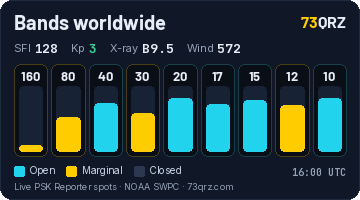
Put this on your site
A free live widget for your club website, QRZ page or forum signature. Solar numbers and band activity, updated every 10 minutes.
Get the free widgetSolar cycle 25
Started December 2019Solar cycles average ~11 years. Cycle 25 is currently near or past its solar maximum, meaning excellent HF propagation conditions on higher bands.
Cycle 25 so far, and the forecast
Historical data + NOAA/NASA forecastBlue: NOAA/SWPC prediction curve. Yellow: observed monthly sunspot number (NOAA, updates monthly). Red: daily international sunspot number from SILSO/Royal Observatory of Belgium.
HF band conditions
Loading...What does this mean for me?
In plain English- Higher bands (10m, 12m, 15m) will be open
- DX (long distance) contacts are easier
- Signals will be stronger and clearer
- Higher bands may be completely dead
- Stick to 40m and 80m
- Geomagnetic storms (K=5+) can wipe out HF entirely
Bands open near you
Live from PSK ReporterWhat's a grid square? A Maidenhead grid (like EM13 or JO31) is how hams describe locations. Find yours at levinecentral.com.
What's being heard right now, from FT8/FT4 spots in the last 15 minutes:
Data from PSKReporter by Philip Gladstone. Shows FT8/FT4 spots from the last 15 minutes. Updated every 5 minutes.
Where can you reach?
Active paths from your region based on current spotsBand activity by hour
When are bands most active? (UTC)Based on PSKReporter spot density. Brighter = more activity.
Your region, last 24 hours
24-hour activity in your area
Last 24 hours of band activity in your grid region (UTC). NOW is at the right edge.
"Your region" = the 2-letter grid prefix (e.g., "EM" covers ~300 miles). Data is from stations in that area.
Activity by continent
Activity by continent (last 15 min)One band, by continent
Select a band to see regional activityBand trends, last 6 hours
Activity over the last 6 hoursSolar flux, last 7 days
A-index, last 7 days
K-index, last 7 days
Understanding the numbers
Solar Flux Index (SFI)
Measures radio emissions from the sun at 2800 MHz. Higher = better HF propagation.
| 70-90 | Poor |
| 90-120 | Fair |
| 120-150 | Good |
| 150+ | Excellent |
K-Index
Measures geomagnetic disturbance. Lower = calmer, better for HF.
| 0-1 | Quiet |
| 2-3 | Unsettled |
| 4 | Active |
| 5+ | Storm |